Buyer’s Atlas
How much power bank belongs in your bag?
A quick phone top-up and a laptop session ask different things of the same USB-C port. Read the small print before you carry the extra weight.
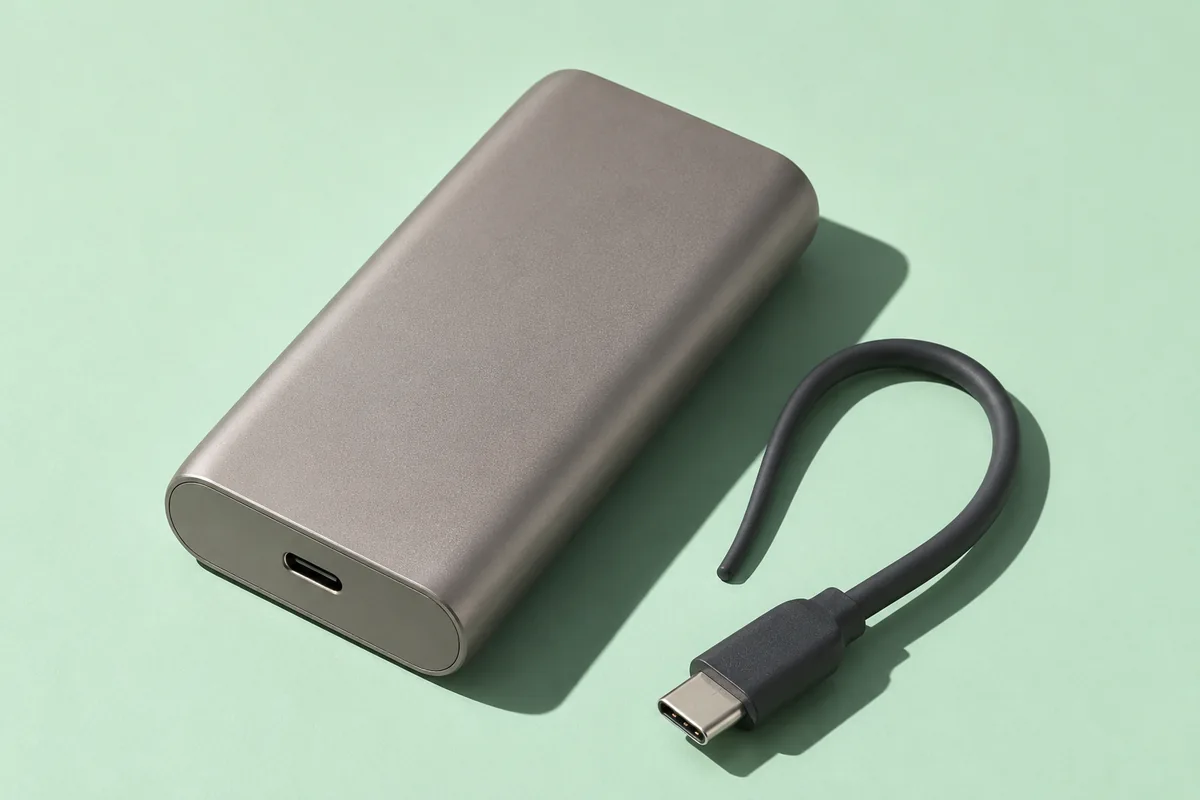
The brand links in this guide go directly to the manufacturer. They are standard editorial links.
What changes when you upgrade?
| Decision | Start with | Consider upgrading to |
|---|---|---|
| What you carry | A compact pack for one phone | More capacity for days with several devices |
| How you charge | One USB-C port that matches your phone | A higher single-port output your device can accept |
| Your cable | A replaceable cable already in your bag | A built-in lead, plus a spare port for flexibility |
Write down what needs rescuing
Think of the last time a device went flat. Was it your phone at dinner or a laptop halfway through a meeting? Find the charging requirements in that device’s manual. For a laptop, compare them with the bank’s single-port USB-C output before spending money on a larger pack.
Read two lines on the specification sheet
Capacity, marked in mAh, and output, marked in watts, answer different questions. On Anker’s Nano A1259, the published figures are 10,000 mAh and up to 30 W from one USB-C output. When more than one device is plugged in, check the shared-output figure. Plan around the way you will actually use the ports.
Try the cable route
Picture holding your phone with the battery in a coat pocket. An integrated lead is convenient when both stay together. A separate cable gives you a choice of length and is easy to replace. Check which ports remain available when the built-in cable is in use.